
Student Advisors
Faculty members play a large role in guiding students into their chosen careers. Your role as a mentor or advisor can shape how comfortable students are advocating for themselves in their internships, externships, and future employment.
Student Employment Rights
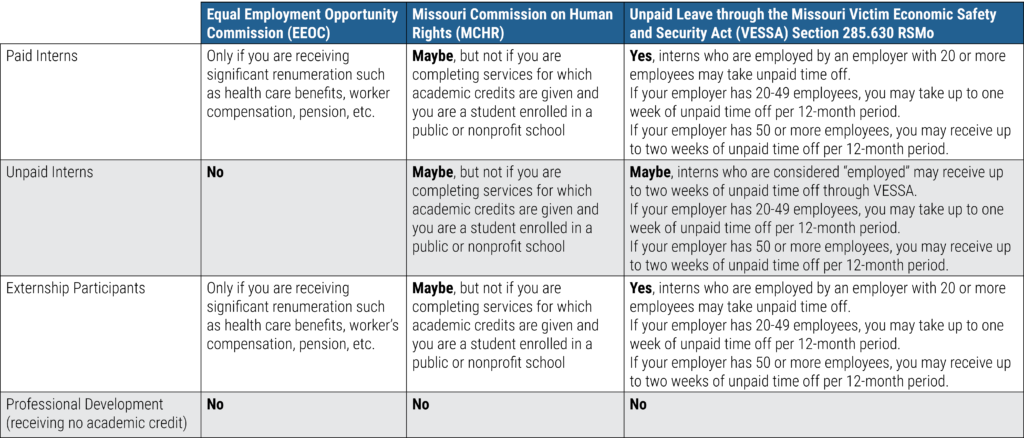
Understanding the statutes that protect and support students can better equip you as an advisor to support students experiencing domestic violence, sexual assault, or workplace harassment. Below is a table with various state and federal laws that protect and support students experiencing domestic violence or sexual assault:
To review:
Interns may be covered by the Equal Employment Opportunity Commission (EEOC) if they are receiving significant remuneration, like health care benefits. The Missouri Commission on Human Rights may provide protections if the intern is not receiving academic credit in return for the work done at the internship. Lastly, interns will receive Victim Economic Safety and Security Act (VESSA) time off as long as the workplace employs more than 20 employees.
Unpaid interns will not receive protections through the Equal Employment Opportunity Commission (EEOC) because they do not receive any payment or remuneration, such as health care benefits. Some unpaid interns may be covered under the Missouri Commission on Human Rights if they are not receiving academic credit in return for any internship work. Finally, unpaid interns may be able to receive unpaid time off through the Victims Economic Safety and Security Act (VESSA) if the employer considers the intern an employee. If they do consider the intern an employee, and the organization employs more than 20 people, the intern may be eligible to use unpaid time off through VESSA.
Externship participants may access protections through the Equal Employment Opportunity Commission (EEOC) if they’re receiving significant remuneration, such as health care benefits. Externship participants may also receive protections through the Missouri Commission on Human Rights if they are not receiving academic credit for their work. Lastly, externship participants who are considered employed by their workplace may access unpaid time off through the Victims Economic Safety and Security Act as long as the employer has 20 or more employees.
Professional Development Participants who are not receiving academic credit for their work cannot receive protections through any of the three listed programs.
Title IX
Title IX is a federal law that prohibits discrimination on the basis of sex in education. Examples of the types of discrimination covered under Title IX may include, but are not limited to sex-based harassment, sexual violence, pregnancy discrimination, discriminatory dress code policies and/or enforcement, and retaliation. It also addresses sexual harassment, gender-based discrimination, and sexual violence. Sexual violence includes attempted or completed rape or sexual assault, as well as sexual harassment, stalking, voyeurism, exhibitionism, verbal or physical sexuality-based threats or abuse, and intimate partner violence. Learn more about Title IX.
While there are some requirements each campus must follow in order to be compliant with Title Ix, each institution may have different policies, practices, or procedures relating to reports of sexual violence or harassment and how the campus investigates the report. This also means that each campus may have different policies for reports relating to sexual harassment or assault experienced by students while working for an internship or externship. Depending on whether the internship/externship program was a requirement of the student’s degree, or if the program was held on campus or by an on-campus organization.
Students may report harassment, intimate partner violence, or sexual assault to you as an advisor. It’s important to relay to the student that you are someone they can trust and that you will help connect them to adequate resources to navigate reporting and/or healing from abuse or harassment.
You may provide information for the student to connect with the campus’ Title IX office to learn more about their options for reporting. You may also connect the student to the campus’ relationship violence organization or office on student wellness. These organizations may be able to connect the student with survivor resources, educate students on Title IX and criminal reporting, and provide general support. You can also find local resources by visiting the How to Get Help tab of our website.


